
Blog
How to Identify Genuine Hallmarked Gold Jewellery: A Complete Buyer’s Guide (2026)

“Buying jewellery is not just about choosing a beautiful design—it is about investing in authenticity, craftsmanship, and trust.”
Gold jewellery has always held a special place in Indian households. It is gifted during weddings, worn during festivals, passed down through generations, and often regarded as both an emotional treasure and a valuable financial asset. Yet, despite its significance, many buyers still focus primarily on appearance, weight, or price while overlooking one of the most important aspects of any jewellery purchase—authenticity.
Whether you’re purchasing your first gold ornament or adding to a family collection, understanding hallmarking can help you make informed decisions and protect your investment.
This guide explains what hallmarking is, why it matters, how to verify it, and what every buyer should know before purchasing gold jewellery.
Why Hallmarking Matters
When purchasing gold jewellery, customers naturally expect that the purity of the gold matches what they are paying for.
Hallmarking provides an independent system of assurance by indicating that a jewellery item has been tested and marked according to prescribed standards. In India, gold hallmarking is administered by the Bureau of Indian Standards (BIS) through recognised Assaying and Hallmarking Centres.
A hallmark does not guarantee the artistic quality or design of a jewellery piece. Instead, it provides confidence regarding the declared purity of the precious metal. For customers, this means greater transparency, improved confidence, and better protection when making a purchase.
Hallmarked jewellery is also generally easier to evaluate for resale, exchange, or insurance purposes because the purity has been certified through the recognised hallmarking system.
Understanding Gold Purity
Gold used in jewellery is rarely 24 karat because pure gold is relatively soft and not suitable for most wearable jewellery. Instead, jewellers combine gold with other metals to improve strength and durability.
Some commonly available purity levels include:
24K Gold
- Approximately 99.9% pure gold
- Primarily used for coins and investment bars
- Generally not preferred for everyday jewellery
22K Gold
- Approximately 91.6% pure gold
- One of the most popular choices for traditional Indian jewellery
- Suitable for bridal jewellery, necklaces, bangles, and other classic designs
18K Gold
- Approximately 75% pure gold
- Frequently used for diamond and gemstone jewellery
- Offers greater durability for contemporary designs
14K Gold
- Approximately 58.5% pure gold
- Increasingly popular for lightweight, everyday jewellery
- Provides enhanced strength for regular wear
Choosing the right purity depends on how the jewellery will be used, the design, and personal preferences. Understanding these purity levels helps buyers compare products more confidently and select jewellery that best suits their needs.
Understanding the BIS Hallmark and HUID
One of the most common questions customers ask is, “How do I know if my gold jewellery is genuine?” The answer begins with understanding the hallmark.
In India, the Bureau of Indian Standards (BIS) administers the national hallmarking system for gold jewellery. Jewellery that has been hallmarked undergoes purity testing at a BIS-recognised Assaying and Hallmarking Centre before being marked in accordance with applicable BIS requirements.
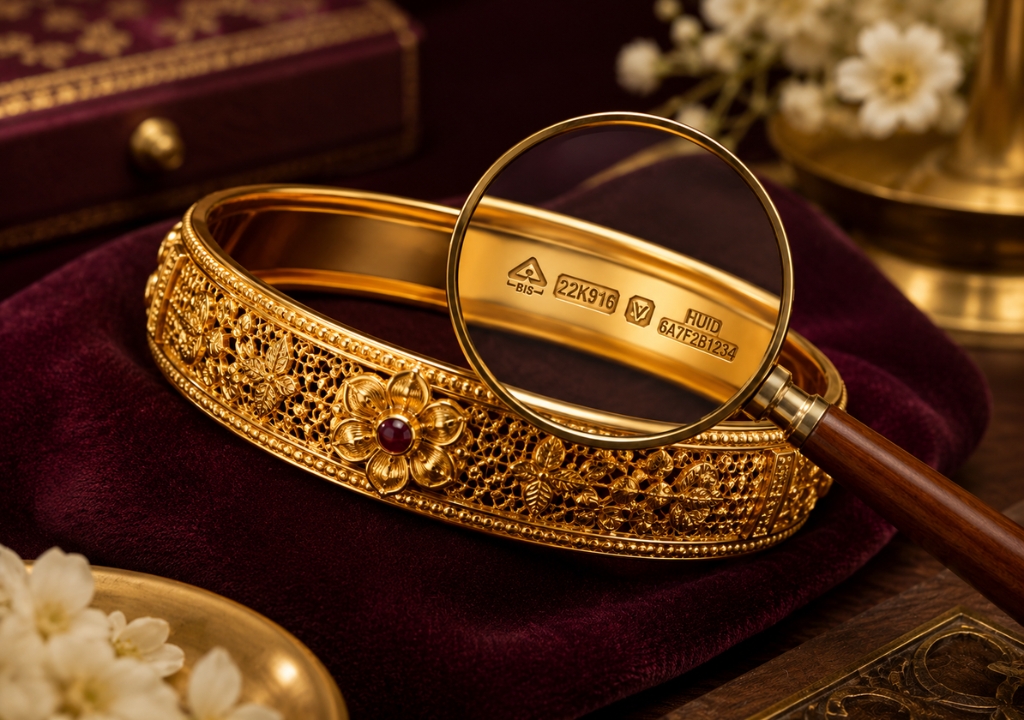
A modern BIS hallmarked jewellery item typically includes:
- The BIS Hallmark – indicating that the jewellery has been hallmarked under the BIS system.
- Purity/Fineness Mark – showing the gold purity, such as 22K916, 18K750, or 14K585.
- HUID (Hallmark Unique Identification) – a unique alphanumeric code assigned to each hallmarked jewellery item.
The HUID has strengthened transparency in the hallmarking process by helping each hallmarked item carry its own unique identity. Customers can use this identification to verify details through official BIS channels, providing an additional layer of confidence when purchasing jewellery.
Before completing your purchase, always take a moment to locate and examine these markings. They are usually engraved discreetly on the jewellery without affecting its appearance.
Simple Ways to Verify Hallmarked Jewellery
Buying jewellery is often an emotional decision, but a few practical checks can help ensure that your purchase is both beautiful and authentic.
1. Look for the Hallmark
Examine the jewellery carefully for the BIS hallmark, purity mark, and HUID. Depending on the design, these markings may appear inside rings, on bangles, pendants, chains, or clasps.
2. Ask Questions
A trustworthy jeweller should be able to explain:
- The purity of the gold.
- The meaning of the hallmark.
- The type of gemstones used (if applicable).
- Applicable buyback or exchange policies.
- Product certifications provided with the purchase.
Never hesitate to ask for clarification before making a purchase.
3. Review the Invoice Carefully
Your invoice should clearly describe the jewellery, including the purity of the gold, weight, pricing details, and applicable taxes. Keeping this invoice safely stored is important for warranty, exchange, resale, or insurance purposes.
4. Verify Through Official Channels
Where available, customers can use the HUID to verify hallmark information through the official BIS verification facilities. Referring to official sources is always preferable to relying on unofficial online claims or social media posts.
Common Misconceptions About Hallmarking
Although hallmarking has become more widely understood, several misconceptions still exist.
Myth 1: Hallmarked Jewellery Means Pure 24K Gold
Not necessarily.
A hallmark certifies the declared purity of the jewellery, whether it is 22K, 18K, or another recognised purity—not that every piece is 24K gold.
Myth 2: Heavier Jewellery Is Always More Valuable
Weight is only one factor.
The overall value of jewellery depends on several aspects, including gold purity, craftsmanship, gemstones (if any), design complexity, and prevailing market prices.
Myth 3: Hallmarking Guarantees Design Quality
A hallmark confirms the purity of the precious metal. It does not assess artistic craftsmanship, comfort, durability of design, or gemstone quality.
These qualities should be evaluated separately by considering the reputation of the jeweller, the manufacturing standards, and the overall finish of the jewellery.
Questions Every Buyer Should Ask Before Purchasing Gold Jewellery
Whether you’re buying jewellery online or visiting a showroom, asking the right questions can make all the difference.
Consider asking:
- What is the purity of the gold used?
- Is the jewellery BIS hallmarked?
- Does it include a HUID?
- What certifications accompany the product?
- What are the exchange, buyback, and return policies?
- Does the product include warranty or after-sales support?
- Are gemstones, if used, natural, treated, or laboratory-grown?
A reputable jeweller should answer these questions clearly and transparently, helping you make an informed purchase with confidence.
Buying Gold Jewellery Online: Shop with Confidence
Online jewellery shopping has transformed the way customers explore and purchase fine jewellery. While it offers convenience and access to a wider range of designs, it also calls for a thoughtful approach to ensure a secure and satisfying buying experience.
Before placing an order, take a few moments to review the jewellery brand’s website and policies. Look for clear product descriptions that specify gold purity, hallmarking information, dimensions, weight, and gemstone details where applicable. High-quality product images from multiple angles and transparent pricing are also signs of a professional and customer-focused brand.
It is equally important to review policies related to shipping, returns, exchanges, and warranties. A reputable jewellery retailer will provide these details clearly, allowing customers to make informed decisions with confidence.
Reading genuine customer reviews, understanding after-sales support, and confirming secure payment options are additional steps that contribute to a safer online shopping experience.
Caring for Your Hallmarked Jewellery
Fine jewellery is designed to be treasured for years, and proper care helps preserve its beauty and longevity.
A few simple habits can make a significant difference:
- Store jewellery separately in soft-lined boxes or pouches to prevent scratches.
- Remove jewellery before engaging in strenuous activities, swimming, or household cleaning.
- Avoid prolonged exposure to perfumes, cosmetics, hairsprays, and harsh chemicals.
- Clean your jewellery gently using a soft, lint-free cloth after wearing it.
- Have valuable jewellery inspected periodically by a trusted jeweller to check gemstone settings and clasps.
These small steps help maintain the brilliance of your jewellery while ensuring it remains a cherished part of your collection for generations.
Why Choosing a Trusted Jewellery Brand Matters
Hallmarking is an important indicator of precious metal purity, but an exceptional jewellery purchase is built on much more than certification alone.
A trusted jewellery brand combines authentic materials with skilled craftsmanship, transparent business practices, and a commitment to customer satisfaction. It provides clear product information, stands behind the quality of its creations, and offers reliable after-sales support.
At Pitambara Jewellery, these principles are reflected in our approach to every creation. Inspired by heritage, craftsmanship, and enduring values, we believe jewellery should cel
